

Ants in your swiftlet house. Do you need to deal with them?
My answer is yes. Do not look down on any pest. They all end up affecting your birds. Ants in a swiftlet house do attack chicks, the ones still sitting in the nest.
What ants actually go after
Yes, when cockroaches and ants build up, the grade and price of your edible birds nest get pulled down. But that is not what a farmer should worry about most.
When ants bite chicks, a whole nest is lost. Nest after nest like that, and the birds slowly get fewer, and in the end the whole house can leave. Selling one harvest for a bit less and losing the birds in the whole house are not on the same scale at all.
Chicks fall for several reasons, like dirty planks and fleas. I went through them one by one in Swiftlet chicks falling and dying on the floor?.
The usual wrong calls
One: hitting them one at a time.
Even today we still see farmers, from time to time, going after cockroaches on the wall with a stick. You can hit one. There are thousands more. How many can you hit?
Two: blaming the plank design.
Someone asked me whether a plank angled at 135 degrees would give cockroaches a place to hide behind. My answer: if you have cockroaches behind that plank, you have them in other places too. However many hidden corners a house has, if the pests are being managed, you basically should not be seeing them. Which corner wood you put up has very little to do with whether you get cockroaches.
How to check, in order
If you need to go in to look, go in the daytime after the birds have flown out.
1. Find out which kind it is.
Ants are not one thing, and neither is the fix:
- Small red ants: an ant killer made for them is enough.
- Big red ants: mix ant powder into animal fat and fish meat, and give it to them as bait.
- Black ants: feed them a gel bait.
If you want it faster, you can first spray a non-toxic insecticide on the plank to deal with the ones you can see, then use bait to finish off the rest.
So I will ask you for a clear photo of the ant before we talk about what to use.
2. Check if the droppings have been collected, then decide where to spray.
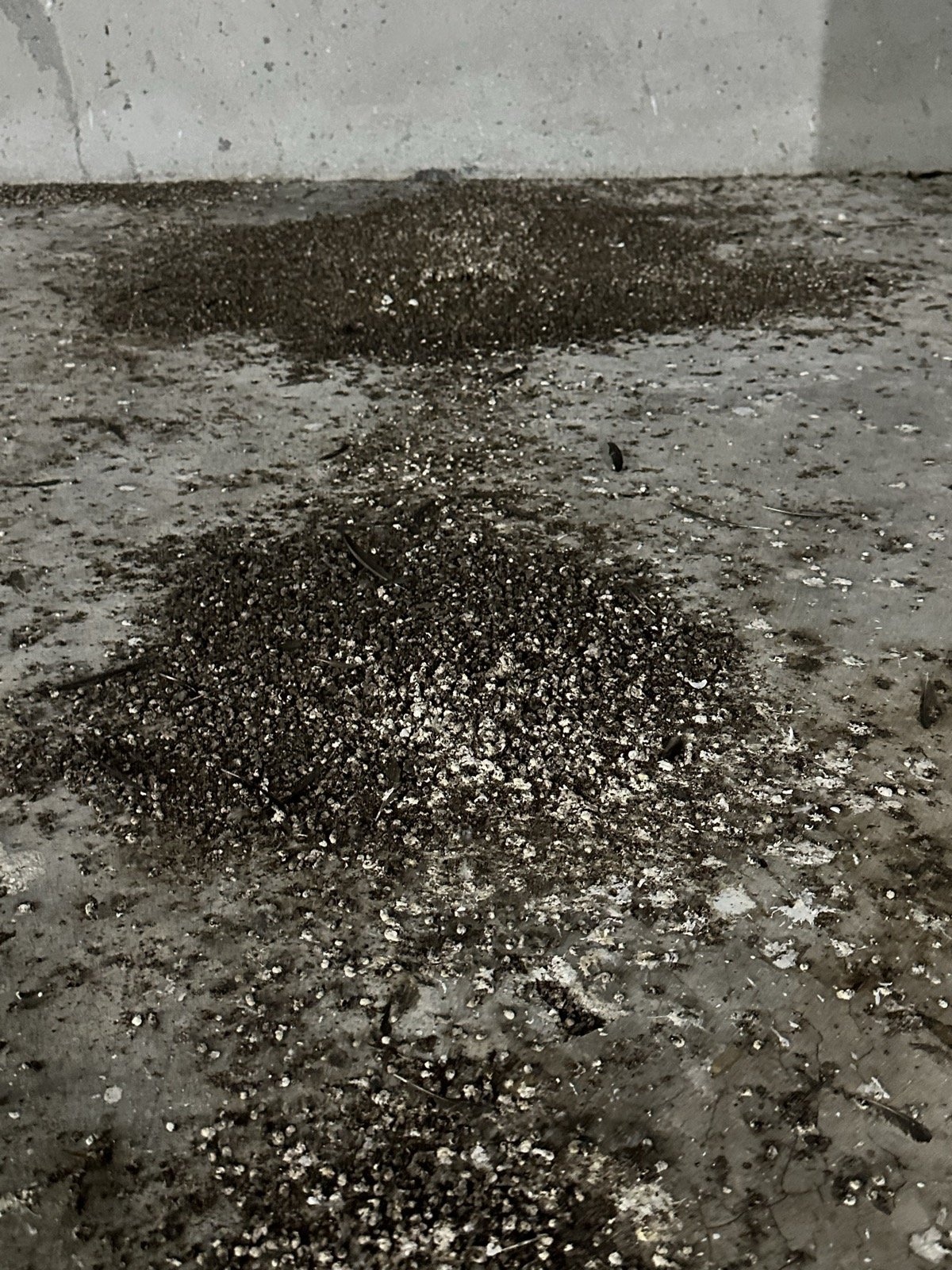
The same tank of pesticide works very differently depending on where it lands, and that depends on whether your droppings are cleared. If they are cleared, spray the band of wall just below the nesting planks and leave the floor, because the insects that lost the droppings to hide in will climb up toward the birds. If they are still there, spray the wet dropping piles and the wall first, leave it a week, then collect. When you sweep, you can leave a few small piles and spray them. Cockroaches go and eat the droppings.
3. If cockroaches are already on the planks, pick the product carefully.
Not every pesticide can go on the planks. Use the wrong one and both the planks and the birds will have problems. Ask before you spray.
4. Handle termites separately.
A swiftlet house stays damp for long periods, and the meranti planks we use are mostly not treated, so termites come easily. If no termite treatment was done before the house was built, watch out even more.
Their trail looks like a line of soil. Leave it alone. The more you disturb them, the more they spread, the harder it gets and the more damage they do. A better way is to draw them in to eat: take old newspaper or cardboard, wet it several times, and leave it in a corner they often pass. Once they start eating it, put termite powder down and let them carry it home. When it reaches the others and the queen, you have a chance to take out the whole colony. You can also drill holes in the ground outside the house and pour chemical in, to make a barrier in the soil. Where you can, choose a pesticide without a strong smell.
When equipment comes in
I treat pests as regular work. Manage them all the time and do not wait for trouble. If you only act once you see chicks in trouble, you have already missed a few chances.
How often to spray depends on how bad the insects are. There is no fixed timetable. Just remember one thing: do not keep using the same product. Every so often, alternate whatever you normally use with Fendona. Use the same one all the time and the insects build resistance, and then spraying does nothing.
If you are not comfortable using something toxic on the planks, we have a non-toxic flea spray that goes straight onto the plank. It stops the protective layer on the insect’s body from working, so it cannot breathe properly and dies. It works on cockroaches, ants, termites and black beetles on the planks. We spray it with a disinfection spray gun, so the planks do not get too wet and it goes further.
Fleas build up when the planks are dirty, the house is too damp and droppings are left piled up. I talked about what a damp house brings in How to increase humidity in a swiftlet house. For the ones that climb in, snakes and rats, read Snake in your swiftlet house?.
Which product to use and which corner to put it in still comes after knowing what insect it is and which way it walks. That is the order of the MDK Swiftlet House Diagnosis Method. Diagnosis first, prescription second.
Your next step
Next time you go in during the day and see ants or termites, do not spray straight away. Get down and take one clear photo, close enough to see if it is red or black, big or small. Then take one of the path it walks: on the wall, on the plank, or in the droppings.
Also film your way in from the entrance hole on your phone, talking as you go, and record the internal sound and then the external sound.
Send it all to us on WhatsApp. It is free. We will tell you what kind it is and what to deal with first. If we need more, we will ask. You do not have to get everything ready at once.