

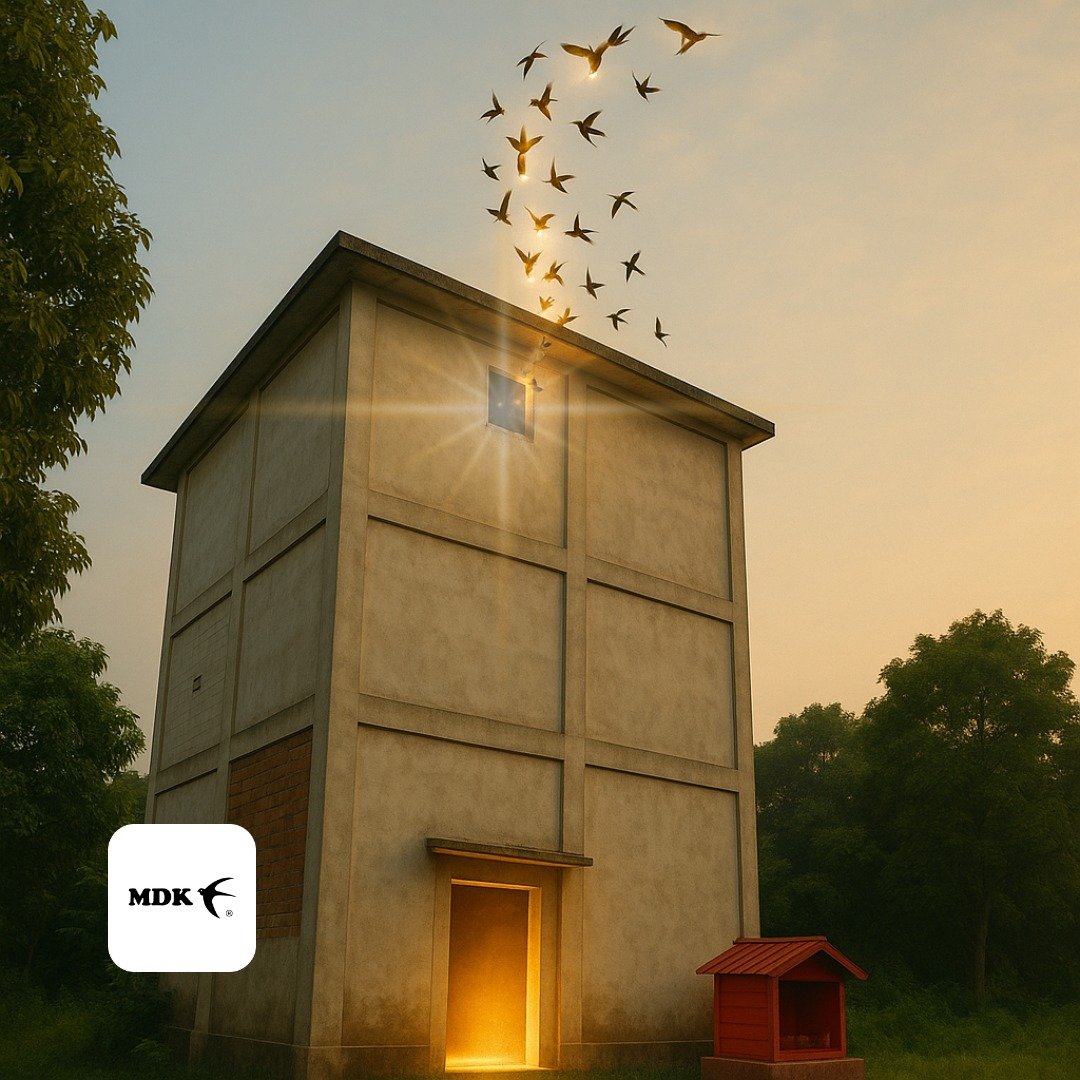
How long has it been since you saw a new nest in your own house?
The house is still standing. The sound still runs. The aroma still gets sprayed. The nest count doesn’t move.
At some point you start accepting an explanation. Maybe the swiftlets around here are thinning out.
Let me be fair about it first. That explanation spreads because it makes sense, not because anyone is being lazy. You don’t see birds. The people nearby say there are no birds. So there are no birds, surely.
But it comes with one side effect, and the side effect is fatal. That answer closes the case in a single sentence, and it asks you to change nothing inside your house.
I had my doubts about it too. So we spent money to find out.
We farmed insects, purely to see whether the birds were still around
The reasoning we started with is the one you’re holding now. Fewer insects, nothing to eat, so the birds moved on.
Fine. Farm insects. We went with black soldier fly.
The first week killed the theory. Once the insects were up and running, the birds came, and there were a lot of them.
The birds hadn’t thinned out. They were there the whole time, and in bigger numbers than I’d assumed.
From that moment the question was a different question. This many birds pass through every day, so why isn’t a single one moving in?
The answer is a little humbling. They were treating the place as a buffet. Eat, leave, don’t even look back.
Two more rounds after that, and I’ll tell you both so you don’t repeat them:
- We moved the insects inside the house. Surely they’d come in to eat. The inside was dark, the birds wouldn’t go in, and the insects ended up dead on the floor in heaps.
- We put lights in so the birds could see the insects. Did more of them stay? No.
Three goes at it before I understood one thing. Where you eat and where you live are two separate questions. Buying somebody dinner doesn’t mean they’re moving in with you.
Where most people read it wrong: “I don’t see birds” isn’t “there are no birds”
A farmer came to buy tweeters. Ten plus years in that house, over a hundred nests.
His opening line was this. All the houses around here are the same, the birds keep getting fewer.
I asked him to send photos first. The moment they opened, there was nothing left to discuss about tweeters.
His entrance was built the way most older houses are. A bird cannot get in through it smoothly.
So that whole row of houses not working has nothing to do with how many birds there are. Everyone’s entrance is wrong in the same place.
The birds turn up daily. They arrive, circle the roof, can’t get in, or get in and decide it isn’t right, and off they go.
This next line is the point of the whole article. Read it out loud:
What you see is “not many birds”. What the bird sees is “I can’t get into any house on this row”.
One situation, two viewpoints, two opposite conclusions. And you’re going to spend the next five years making decisions based on yours.
He looked deflated hearing it. I know that tiredness. Changing things, waiting, being let down, changing again. I spent years in it myself. But if the deflation points you the wrong way, the years after cost even more.
“There are too many swiftlet houses in my area.” Fifteen years of hearing that one.
The people who say it are usually three to five years in. House built, money gone, birds come and go.
I usually answer with one word. Congratulations.
Plenty of houses means the birds are already flying there. You don’t even have to invite them. That leaves one question. Why are they picking the house next door instead of yours?
Think how you choose a hotel. Same street, two places that look about equal, which one do you walk into? The bird does the same thing. It just isn’t shopping for a bed. It wants somewhere it can get into, stay in, and get chicks out of.
In the most crowded areas, the house next door is still full. You’ve seen it yourself.
I’ve also seen the reverse, and that one stuck with me.
Fourteen years ago I looked at a house sitting in the middle of paddy fields. Nothing but fields in every direction. Almost nobody else nearby. Food, flight paths, every condition looked beautiful. The kind of spot people dream about.
Nine months open. Not one complete nest.
Walked through it once and the problems surfaced one after another:
- A water pool directly under the air well. Sun hits it, light bounces up, birds won’t fly down through that
- Internal sound so loud a person couldn’t stand to be in there
- The railing at the LAL built too high, so the birds couldn’t get down to the lower floors
- Old guano spread across the floor that had lost its smell years ago
Full marks for location. The house failed. Nine months of work and the answer was zero.
Location matters, and I’m not arguing it doesn’t. But what it decides is fast or slow, not alive or dead. Good location plus a house built right grows quickly. Ordinary location plus a house built right still grows. The hard one to save is the other kind: an ordinary location, and a house nobody has ever properly looked at.
When equipment finally comes into it
Everything you can actually move is inside your own house.
How many birds there are, how many insects, how well your neighbour does, you can’t move any of it. Blaming the outside is the most expensive road there is, because when you’re done blaming you’re standing where you were, while the money and the years keep going.
Inside the house is the opposite. Every item can be checked. Does the entrance flow. How deep does the light reach. Are there spots in the plank zone that are dead. Where is the sound actually landing.
That’s the job of the MDK Swiftlet House Diagnosis Method. Turn those over one at a time, find the gate it’s stuck at, and only then talk about moving anything. People who run it backwards buy a pile of equipment first and blame the location last.
Want to change something small and test the water? Go ahead. That’s how we’ve always done it, step by step. Nobody has to spend big on day one. Just test the water in the right pool.
Your next step
Don’t farm insects. Don’t rush to change anything either.
Film your way in from the entrance hole on your phone, talking as you go, and record the internal sound and then the external sound.
Drop it in our inbox and I’ll go through them first. Free.
Once I’ve seen it, we can have the conversation about whether your area still has birds. Most of the time, it does.
(If you want the single thing most often built wrong inside the house, it’s here: Does a swiftlet house need to be completely dark?)