This is the question customers ask us most. Our answer has always been the same: you do not need everything. You add what your house is missing, and only that. Below are the three situations farmers run into most. Find yours and read that group only.
Birds that get in but will not stay are often missing one thing: a scent that says other birds live here. This group has only one product. You just need the right one for a new house or an old one.
NBH is the scent that draws swiftlets in to settle. There are no droppings in it and no ammonia. What it releases are the elements swiftlets need to look for a partner and mate, so they settle in more easily.
It stinks. Really stinks. But that smell is meant for the birds, not for you.
DSA is built on NBH: 80% NBH plus 20% droppings extract. A new house has no droppings smell yet, and that extra 20% fills exactly that gap.
So you do not buy both. DSA already contains NBH. An old house already has plenty of its own droppings, so another layer is redundant. NBH is enough.
Not sure whether yours counts as new or old? Tell us roughly how many nests you have and we will tell you which one.
This is a start, not the finish. Once you have used it and see a few more birds, that is when we can really help: send us a video of the inside of your house and we will look at it for free: how much more this house can grow, and where it gets stuck next.
Ageing is one of the most common roots of falling production, and the planks are the part of it you can deal with today, no walls to break, no structure to change. One more thing to know: by the time you can see mould, it has already been growing for a while.
People often think we are selling timber. We are not. It is not a scent for attracting birds either. It is for the planks: it prevents mould and removes odour, and you spray it on without climbing up to wipe each plank. Spraying new planks before they go up costs far less than rescuing them later.
Clean planks are what let the bird count grow. We needed this product ourselves first: the planks in our founder's father's house were all mouldy, nobody could give an answer, so we had a factory make a version just for swiftlet houses.
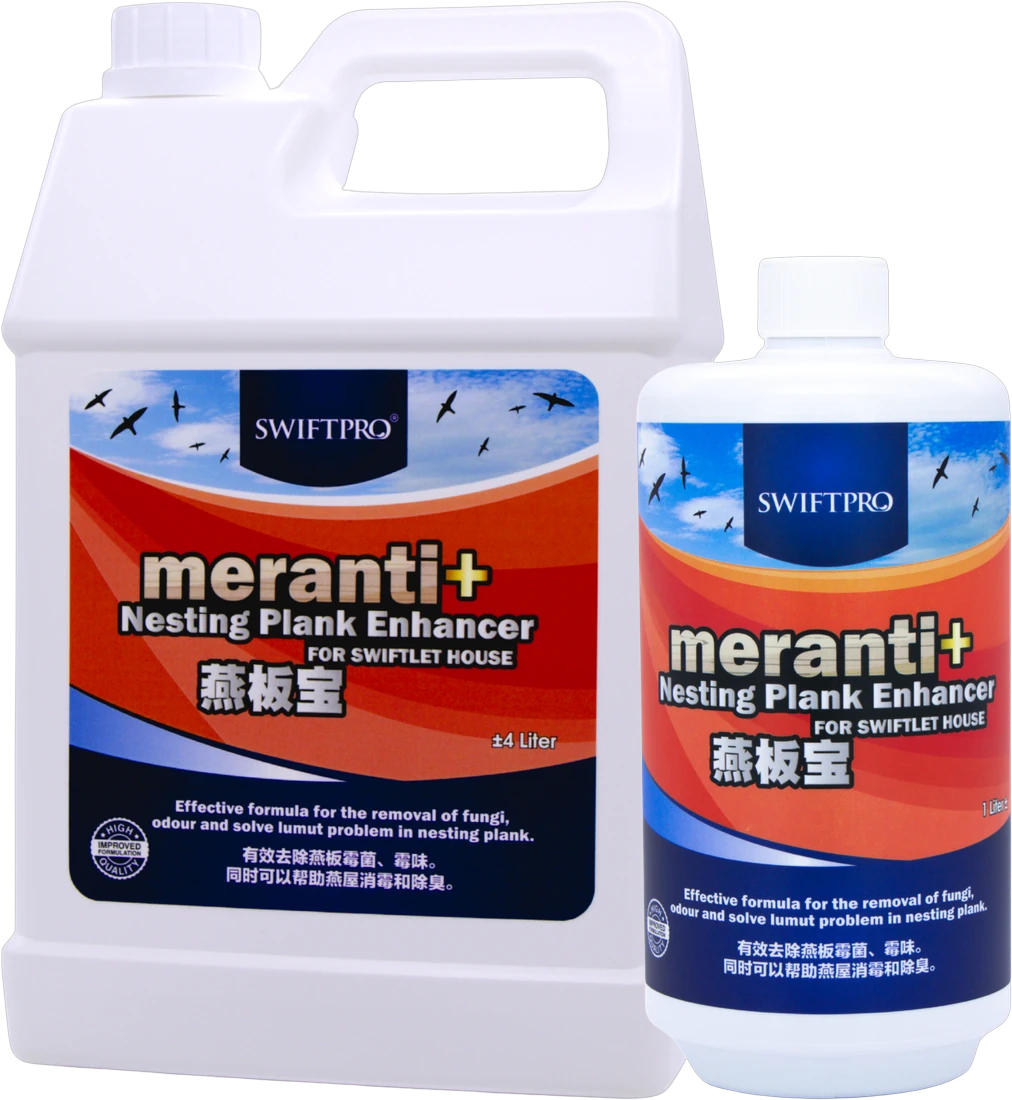
Chalcid, Fendona and that class are high concentration pesticides. They must not go on the planks.
Why that order: with Meranti+ on the planks, the pests can no longer settle there and try to escape downward. You are waiting for them below, so one pass does it. If the infestation is bad enough that the planks themselves must be treated, you need a pesticide that is suitable for planks. Getting that wrong costs you a whole ceiling of planks, so ask us first.
One more thing: finish spraying before 1pm (12pm in East Malaysia), so the planks are dry before the birds come home.
Is it the planks, or the air? A video usually shows us. Send us a video of the inside of your house and we will look at it for free. In some cases you do not need to buy anything.
Sound is the last step, not the first. Check the flight path first, then the spots where the birds live, and only then the sound. Good sound in a house that does not flow does not just fail. It brings more birds in to take a look, find nowhere to stay, and not come back.
External sound is the signboard that calls passing swiftlets down. Internal sound is the food inside that gets the ones who came in to settle. However loud the signboard, if the food is bad the customer sits for a moment and leaves. So the two are handled separately, not covered with one sound.
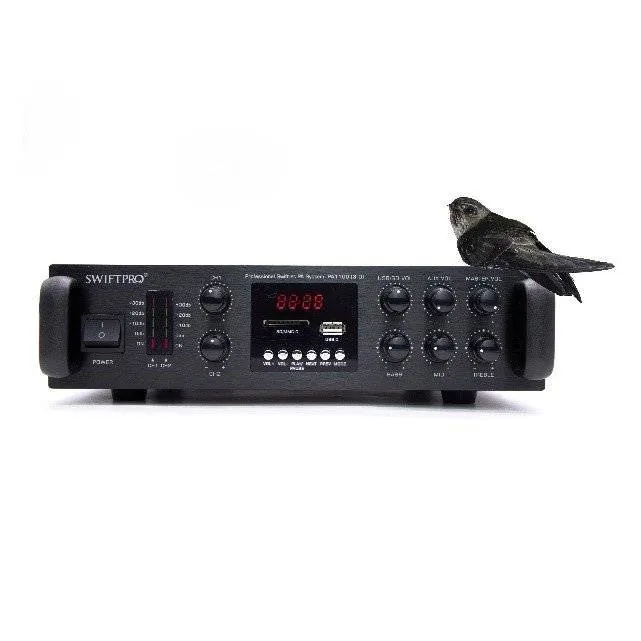
3.0 is the best sounding internal sound amplifier we have right now. PRO+ controls the low, mid and high of its two channels completely independently, one to the outer hole and one to the inner hole.
Good external sound makes the birds more willing to come and play. Good internal sound gets them to settle faster. Both matter, but which one your house needs first, and whether you need a new machine at all, comes after a diagnosis. Sometimes the answer is “the tuning is off, fix that, no new machine”, and then that is what we tell you.
The back uses copper, not iron, so it does not rust in a swiftlet house. The back cover is thicker, so the sound does not leak out behind. We ran 8 kinds of tweeters side by side in our shop for three months, and the birds chose the 25P to nest on first.
You can check this yourself: look at where the nests are. Nests in front of a tweeter mean a good tweeter. Birds all nesting behind it usually means it is leaking sound.
Which tweeter goes in which section, and how they are arranged top to bottom, depends on your house. We go through it one by one in the masterclass. It does not fit on this page.
Which machine and which tweeter suit your house, we can only say after looking. Send us a video of the inside of your house, recording the internal sound first and then the external sound, and we will listen for free.
No. Most houses are stuck in one group, and some do not need any of them because the problem is at the entrance hole or in the layout. Find your group first. Not sure? Send us a video and ask.
No. DSA is 80% NBH already. A new house with fewer than 100 nests uses DSA, an old house uses NBH. One or the other.
We do not recommend it. Wet planks grow mould easily. NBH is for the scent, and the planks are a job for Meranti+. More about NBH
There is a free external sound available now. Just ask customer service on WhatsApp. But sound is not a cure-all: if your house is stuck at the entrance or the flight path, a new external sound will only make things busy for a few days. When you collect it, send a video of your house along with it. Use the sound, and at the same time we will look at where it is really stuck.
Prices change, so we keep them in our shop, Kedai Dr.Burung, where they are always current. This page only covers which product fits which problem.
Take your phone and film your way in from the entrance hole, talking as you go. Record the internal sound for a while, then switch to the external sound and record that too, and send it to us. It does not have to be a good video. If we need more after looking, we will ask. You do not have to prepare everything at once.